
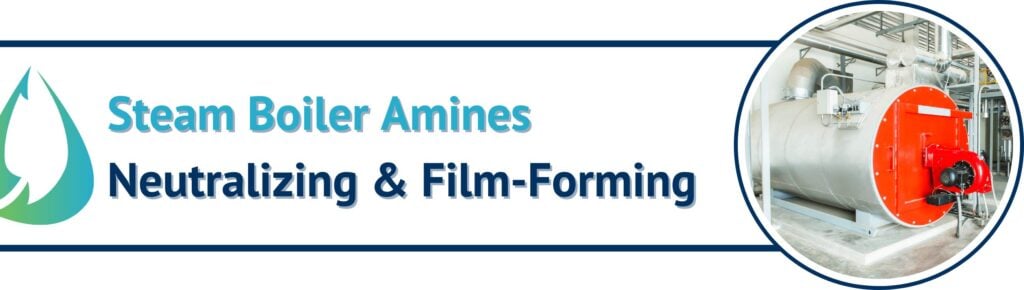
The condensate lines in steam boilers are prone to corrosion. This is due to condensate water in the steam boiler reacting with carbon dioxide (CO2). This reaction can form carbonic acid, which corrodes the metal condensate line piping. The solution for this is to use amine chemicals in the condensate lines.
There are two main types of boiler amines: neutralizing and film-forming.
Neutralizing amines increase boiler pH and help “neutralize” carbonic acid. It is important to maintain a pH in a range of 7.5-9, as these amines can be corrosive to copper in other conditions. Neutralizing amines dissolve completely in water. The steam can also carry them throughout the boiler system. There are different amine ranges you can purchase based on how far you need the amine to travel in the system. You can inject the chemical into the feedwater tank.
Morpholine
Cyclohexylamine
Diethylaminoethanol
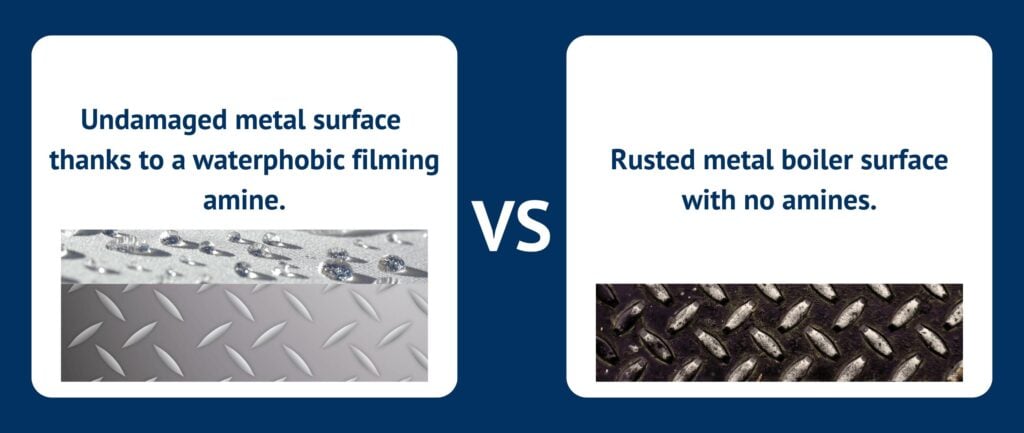
Filming amines creates a monomolecular film which acts as a protective layer from carbonic acid corrosion. Filming amines do not dissolve in water like neutralizing amines; due to this, you need to feed them into the steam header to carry them throughout the system. It is important to gradually feed filming amines, especially in steam boilers with corrosion deposits and oxygen leaks. It could build up in certain areas of the piping otherwise. The way filming amines work to prevent corrosion in condensate lines is by being hydrophobic. The amine binds closely to the metal piping while repelling the water away from the metal surface.
Octadecylamine (ODA)
Ethoxylated Soya Amine (ESA)
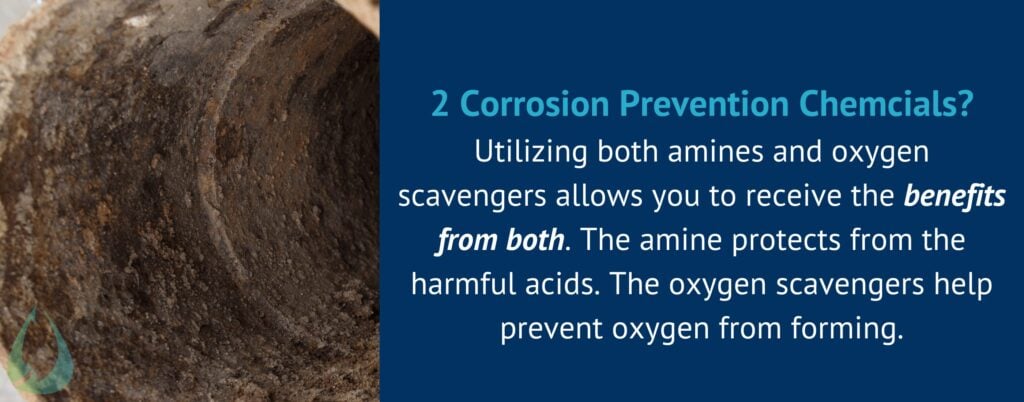
You can use amines and oxygen scavengers together to help prevent corrosion effectively in steam boilers. As mentioned previously, amines passivate metal surfaces / form a protective layer. Oxygen scavengers remove oxygen from water. These are both ways to prevent corrosion in steam boiler condensate lines, and when used together, it is incredibly effective. There is a chemical called Diethylhydroxylamine (DEHA) that mixes amines and oxygen scavengers together. It is made from a reaction of an amine called triethylamine and a peroxide.
Steam boilers have multiple applications in a healthcare setting. This can include steam sterilization, humidifying, and heating. If it is used as a humidifier, it must comply with ANSI/ASHRAE Standard 170-2013 Ventilation of Health Care Facilities / FDA regulations 21 CFR 173.310 Boiler Water Additives. Basically, the amine chemical must be considered “food-safe” in case it comes in contact with food or is breathed in by patients or workers. Just like other applications, hospitals and other healthcare facilities need to prevent corrosion in their boilers, and amines are an effective way to do that.
Chardon Labs utilizes amines, corrosion inhibitors, scale inhibitors, pH adjusters, and other chemicals to effectively treat steam boilers. We routinely feed chemicals to ensure that your system always has treatment. Additionally, we use remote monitoring equipment to check up on your system, carefully examining the chemistry of your water to help prevent problems and improve system efficiency. To learn more about our offerings and book an appointment, go here.